• Home
  • Our Animals
  • Presentations
  • About
  • Mission
  • How To Help
  • Contact Us
  • New News

Birds

Colorful, beautiful, loud, smart, and amazing. Birds are wonderful animals to know and understand. See Animal Wonders' bird residents below and learn a little more about these beautiful animals. Click on their pictures to see their biography.
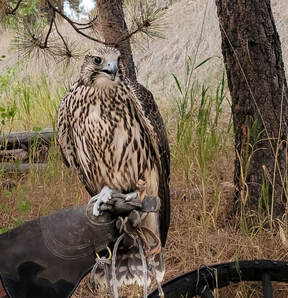
Curly

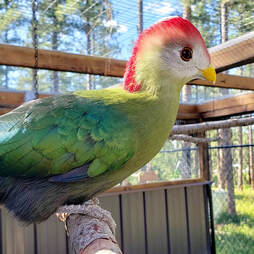
White-Cheeked Turaco (Tauraco leucotis). Turacos are also known as go-away birds and plantain eaters. They are found in southern and eastern Africa high up on the branches of the canopy. These birds are experts at running along the twisting and winding branches. They eat mostly fruit but occasionally will find a small insect to swallow up whole. Unlike parrots, turacos don't have a beak that is used to crack nuts and pull apart wood, they are called soft-bills. That doesn't mean they have a soft bill, it means they swallow their food whole instead of munching it up.
Turacos have a brilliant plumage and come in many different colors. They are all similar because they have red hidden on the flight feathers of their wings. When perched it is almost invisible, but as soon as they take flight they flash the splendid crimson across the sky. They are also unique from any other bird because of that red coloration. If you put one of those red feathers in a glass of water, the water will turn red. The red pigment is caused by copper that is water soluble. No other feather does this amazing trick.


Toucanet

Picture
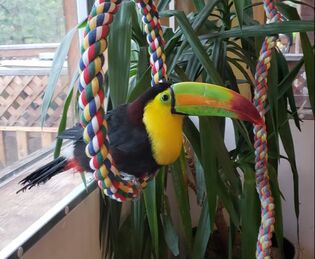
Crimson-Rumped Toucanet (Aulacorhynchus haematopyus). These beautiful and unusual birds are found in the humid Andean forests of South America. They in the same family as toucans and you can see why, look at that beak! Toucans and toucanets do not use their beaks to pierce their food, instead they grab the piece of food in the tip of their beak and then toss it to the back of their throat. They eat mostly fruit and insects, though they will occasionally eat a rodent or lizard. Toucanets smart, active, and social. They enjoy jumping from branch to branch high up in the trees looking for their next meal of berries.

Zoe

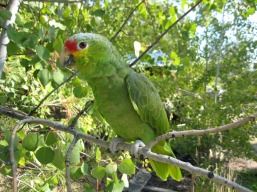
Red Lored Amazon parrot (Amazona autumnalis). These birds are found in the wild in South America. They live in large groups called flocks.  In the wild they eat fruit, vegetables, flowers, seeds and leaves from the trees they love to play in.

Parrots are birds that are known for their ability to "talk" like humans. Many people have a parrots as pets because of their intelligence and beauty. These birds can live 60-80 years old! Sometimes a pet parrot has to be put in the owner's will because they outlive their human!
Parrots have really neat feet. Instead of 5 fingers and toes like us. They have 4 toes, 2 in the front and 2 in the back. This helps them hold onto branches. Their toes are so strong that they can hang upside down by one toe!
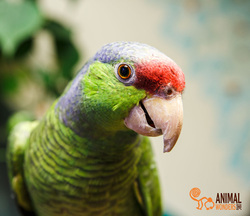

Chongo

Lilac Crowned Amazon parrot (Amazona finschi). These birds live in South America in humid rainforests. They live in large flocks and eat fruits, flowers, seeds, etc. Parrots can live 60-80 years old! Most parrots have the ability to talk. Some never say a single human word and others say over 100 words!

Like other amazon parrots Lilac crowned Amazons can mimic but are not as outgoing as other species. They are shy but can learn to be confident with a supportive family and lots of practice.
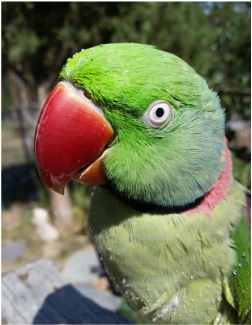

Ringo

Picture
Meyer's Parrot (Poicephalus meyeri). The Meyer's Parrot can be found in sub-Saharan Africa in forests surrounding savannahs. They enjoy eating fruits, berries, seeds, and grains. They are considered pests because of their love of eating the cultivated crops of farmers. Meyer's Parrots come in several different colors: green, blue, or turquoise. And some do not have yellow on their heads. This is due to different subspecies that occur in different forests in the wild. They are smaller that Amazon Parrots but larger than most conures. They are easy going and are quite well known in the pet trade. Since they are great at adapting to their changing environment, note that they eat human crops, they are not in danger of dropping in population anytime soon.

Oliver

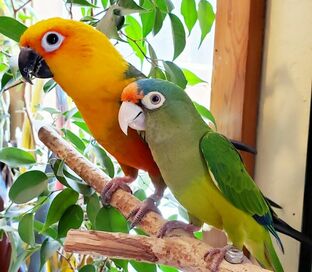
Sun Conure (Aratinga solstitalis). These birds are smaller than a parrot and larger than a parakeet. Sun conures are known to be the loudest of the conures but they are also the most colorful. They live in flocks of up to 30 and confuse their predators by all their bright colors.
They live in South America in humid forests where they spend most of their time looking for food. They eat fruits, flowers, berries and nuts. These birds were named for their bright yellow color.


Loulou

Picture
Halfmoon Conure (Aratinga canicularis).Info coming soon.

Ginger

Picture
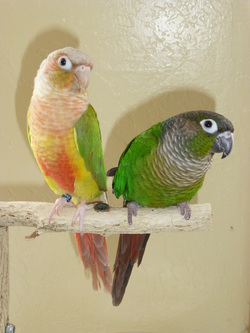
Green Cheek Conure (Pyrrhura molinae). Green cheek conures are found in southern Brazil and northern Argentina in forested areas. They form huge flocks and eat seeds, berries, fruit, and grains. They are one of the smaller conures and are commonly kept as pets. They are known for their loving and curious personality. If well taken care of and given a healthy diet, green cheek conures can live up to 35 years.

Ray

Picture
Rainbow Lorikeet (Trichoglossus haematodus). These beautiful birds have almost every color of the rainbow on their feathers. They are found on Australia and the surrounding islands. Lorikeets live in and around rainforests living in pairs and sometimes flying in a flock. They have a shrill call but can mimic sounds very well. Lorikeets have a very special diet. They eat mostly nectar and pollen and sometimes eating fruits, veggies, and also occationally a bug or two. Their tongues have a special brush on the tip so they can soak up the nectar they so love to eat.

Sunny

Picture
Pacific Parrotlet (Forpus coelestis). These are the second smallest bird in the parrot, or Psitticine, family. They are only about 4-5 inches long and are sometimes called "pocket parrots". They live in South America, Ecuador and Peru, in tropical dry forests. There are 7 species of parrotlets and the Pacific Parrotlet is the most common in the pet trade. They can live up to 30 years and have the ability to mimic human words! Parrotlets have a voracious appetite and they love to eat and play all day. They have a personality like an Amazon Parrot in a itty bitty package so watch out for that attitude!

Lovie

Picture
Peach-Faced Lovebird (Agapornis roseicollis). In the wild, lovebirds are found in southwest Africa. They are small but energetic birds that love to keep busy. They are known for sleeping snuggled up to their partner with their faces turned toward each other. Females will sometimes put small pieces of materials under their wings and fly home with it to help build their nests. Lovebirds eat mostly seeds and berries. Sometimes they are considered a pest because they will eat corn and other crops grown by farmers in Africa. They are common pets and can learn to mimic human words though they aren't quite as good at it as the larger parrots.

Joli

Picture
European Starling (Sturnus vulgaris). Starlings can be found almost everywhere in the world. There are many species of starlings but the one known best in North America is the European Starling. They are not native to American but in 1890 one hundred were let loose in New York and they began to breed and take over other native bird's nests. They are now found all over North America and are considered pests, animals that are not native to an environment are called Invasive Species. European starlings are intelligent and aggressive and are able to push other native birds out of an area such as, wrens, swallows, and bluebirds. They have a unique way of finding food that helps them out-compete native birds; they use their beak to pry open and gain access to foods other birds wouldn't be able to eat. They are also very good at mimicking and learn the songs of other birds, mechanical noises, and can learn human words as well. European starlings are not welcome in most American backyards, but they are an interesting species and it's worth learning about what an invasive species can do to an environment.

Willow

Picture
Ring Neck Dove. Info Coming Soon.

Lady

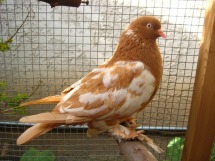
Fancy pigeon (Columba livia). Fancy pigeons are just fancy looking pigeons. They were bred by pigeon breeders to look different just like dogs are bred to look different. There are over 100 different breeds of pigeons and they all came from the rock pigeon from Europe. Some fancy pigeons are bred to have extra feathers on their feet, or tails that look like fans, or have a talent for finding their way home like homing pigeons.
Pigeons eat just about anything they can find but if you keep them as pets they need to have a special pigeon food. People sometimes call them rats with wings because there are so many in cities. These city pigeons are mutts, mixed breeds that flourish around large populations of humans.
Pigeons are monogamous, keeping their mate for life. The parents make a team effort in raising their young. Usually the father takes the night shift sitting on the eggs and the mother takes over for the day.


Back to Our Animals

www.animalwonders@email.com